PRESS RELEASE
Freetown, Sierra Leone, 7 March 2007
The body of Sam Hinga Norman was handed over to family members today after being returned to Sierra Leone from Dakar, Senegal.
Mr. Norman’s body was flown by helicopter from Lungi International Airport to the United Nations headquarters in Freetown, arriving just before 1:00 p.m.
In a brief but solemn ceremony, Special Court Registrar Lovemore Munlo, SC and a representative of the family signed a document which formally handed the body over to family members.
Mr. Norman was taken to Dakar last month for a routine medical procedure which is not available in Freetown. The procedure was performed successfully on February 8. On February 22, Mr. Norman collapsed in his hospital room. Doctors attempted unsuccessfully to revive him.
Wednesday, March 7, 2007


IMPUNITY FOR WAR CRIMES AGAINST WOMEN
By Louise Arbour
United Nations High Commissioner for Human Rights
The plight of victims of sexual attacks during conflict has come to the fore once again when last week, the International Criminal Court’s Prosecutor requested summons for two Sudanese connected with atrocities in Darfur. According to the Prosecutor, there is strong evidence pointing to the suspects’ responsibility for mass rape and other war crimes. Previously, the ICC had issued an arrest warrant for the leader of the Lord Resistance Army, a rebel group in Uganda, on the ground of war crimes, including ordering sexual enslavement and rape.
Thus, ICC action is gearing up to bolster the cumulative experience of international justice mechanisms that have brought to light specific types and patterns of sexual crimes targeting mainly women and girls in war torn zones, as well as identified individual responsibilities in their commission. The work of these courts has also highlighted the difficulties in prosecuting perpetrators and countering the culture of impunity that shields their criminal acts. Such impunity, of course, permeates all societies, be they peaceful or at war. Not by coincidence, this year International Women Day is dedicated to combating this pervasive lack of accountability. It is, however, in times of war that the effects and consequences of impunity are at their starkest. This is due both to the widespread, systematic and often sustained nature of sexual attacks and to the number and callousness of perpetrators.
Although at their most brutal in war, sexual abuses against women often stem from longstanding prejudices, a lack of equality and discrimination that had condoned such violence all along. When perpetrators go unpunished, they are emboldened to strike again, perpetuating and encouraging vicious cycles of attack and reprisal even when a country emerges from conflict. Rendering justice to the victims is, therefore, not only a moral imperative, but also a precondition for reconciliation and peace to take hold.
Yet, sexual violence has been traditionally underreported and under-prosecuted. As a result, such crimes have long been considered as regrettable but unavoidable byproducts of armed confrontation. Women as victims or pawns of belligerents could demand no recourse.
Only recently has this powerlessness been addressed, primarily by the groundbreaking work of the International Criminal Tribunals for the former Yugoslavia and Rwanda. The tribunals defined systematic violence against women as crimes for which those responsible could be held accountable, thereby empowering victims to have their day in court. The creation of the International Criminal Court gave an additional boost to such emerging jurisprudence and changing mind set. Its statute stipulates that rape, sexual slavery, enforced sterilization, or any other forms of sexual violence of comparable gravity are considered as war crimes. If these acts are committed as part of widespread or systematic attacks on a civilian population, they constitute crimes against humanity.
It now remains to be seen whether governments will accede to the Court’s requests and surrender the suspects for trial. But if government non-compliance is potentially the main obstacle to the course of international justice, there are other factors that hamper prosecution. Victims of all forms of violence are often reluctant to come forward, in large part because they have little confidence that justice will be done. Although some of the perpetrators may have been apprehended, others, as well as their accomplices, may remain at large and therefore capable of inflicting further harm to victims, witnesses and their families.
The Special Court for Sierra Leone has made strides in addressing such hindrances in the face of a monumental task: as the result of ten years of conflict and the belligerents’ methods of warfare in that country, the brutality of sexual violence was extraordinary, and its victims were to be counted in the thousands. The Court benefited from its proximity to the victims, the parallel work of a Truth and Reconciliation Commission and a framework that protected the victims and ensured that their dignity was preserved. The ICC, too, is building on previous experiences and strengthening legal assistance and protection for victims.
Although the mandate and machinery of international courts have become increasingly more sophisticated and far-reaching over the years, gender justice continues to remain the exception rather than the rule. Successfully prosecuted cases represent just the tip of the iceberg. The crux of the matter in combating impunity is the requisite political will to tackle it. Often slow to gear up into motion, such political will needs to be mobilized through domestic and international pressure as well as continuous scrutiny.
United Nations High Commissioner for Human Rights
The plight of victims of sexual attacks during conflict has come to the fore once again when last week, the International Criminal Court’s Prosecutor requested summons for two Sudanese connected with atrocities in Darfur. According to the Prosecutor, there is strong evidence pointing to the suspects’ responsibility for mass rape and other war crimes. Previously, the ICC had issued an arrest warrant for the leader of the Lord Resistance Army, a rebel group in Uganda, on the ground of war crimes, including ordering sexual enslavement and rape.
Thus, ICC action is gearing up to bolster the cumulative experience of international justice mechanisms that have brought to light specific types and patterns of sexual crimes targeting mainly women and girls in war torn zones, as well as identified individual responsibilities in their commission. The work of these courts has also highlighted the difficulties in prosecuting perpetrators and countering the culture of impunity that shields their criminal acts. Such impunity, of course, permeates all societies, be they peaceful or at war. Not by coincidence, this year International Women Day is dedicated to combating this pervasive lack of accountability. It is, however, in times of war that the effects and consequences of impunity are at their starkest. This is due both to the widespread, systematic and often sustained nature of sexual attacks and to the number and callousness of perpetrators.
Although at their most brutal in war, sexual abuses against women often stem from longstanding prejudices, a lack of equality and discrimination that had condoned such violence all along. When perpetrators go unpunished, they are emboldened to strike again, perpetuating and encouraging vicious cycles of attack and reprisal even when a country emerges from conflict. Rendering justice to the victims is, therefore, not only a moral imperative, but also a precondition for reconciliation and peace to take hold.
Yet, sexual violence has been traditionally underreported and under-prosecuted. As a result, such crimes have long been considered as regrettable but unavoidable byproducts of armed confrontation. Women as victims or pawns of belligerents could demand no recourse.
Only recently has this powerlessness been addressed, primarily by the groundbreaking work of the International Criminal Tribunals for the former Yugoslavia and Rwanda. The tribunals defined systematic violence against women as crimes for which those responsible could be held accountable, thereby empowering victims to have their day in court. The creation of the International Criminal Court gave an additional boost to such emerging jurisprudence and changing mind set. Its statute stipulates that rape, sexual slavery, enforced sterilization, or any other forms of sexual violence of comparable gravity are considered as war crimes. If these acts are committed as part of widespread or systematic attacks on a civilian population, they constitute crimes against humanity.
It now remains to be seen whether governments will accede to the Court’s requests and surrender the suspects for trial. But if government non-compliance is potentially the main obstacle to the course of international justice, there are other factors that hamper prosecution. Victims of all forms of violence are often reluctant to come forward, in large part because they have little confidence that justice will be done. Although some of the perpetrators may have been apprehended, others, as well as their accomplices, may remain at large and therefore capable of inflicting further harm to victims, witnesses and their families.
The Special Court for Sierra Leone has made strides in addressing such hindrances in the face of a monumental task: as the result of ten years of conflict and the belligerents’ methods of warfare in that country, the brutality of sexual violence was extraordinary, and its victims were to be counted in the thousands. The Court benefited from its proximity to the victims, the parallel work of a Truth and Reconciliation Commission and a framework that protected the victims and ensured that their dignity was preserved. The ICC, too, is building on previous experiences and strengthening legal assistance and protection for victims.
Although the mandate and machinery of international courts have become increasingly more sophisticated and far-reaching over the years, gender justice continues to remain the exception rather than the rule. Successfully prosecuted cases represent just the tip of the iceberg. The crux of the matter in combating impunity is the requisite political will to tackle it. Often slow to gear up into motion, such political will needs to be mobilized through domestic and international pressure as well as continuous scrutiny.
Reporters on the Job: the case of GNN’s Cholo Brooks’ Trip to Guinea
INTO GUINEA: Recently I, (Publisher of the GNN, J. Cholo Brooks) traveled to the Liberian/Guinean border, specifically by way of Ganta, Nimba County, in order see if the situation in Guinea between Trade Union leaders and the government was now over, and also to cover report on the influx of thousands of Liberian refugees who fled that country due the fracas.
The situation at the Liberian/Guinean border was calm and friendly as both Liberian and Guinean securities that were approached by my presence showed the kind of receptiveness, and spoke highly of the cordial relationship between them.
“We are working together to see to it that our borders are well protected. Even though, as you can see hundreds of Liberian refugees have been crossing over from Guinea daily for fear of been trapped in the conflict,” a Liberian Immigration Officer neatly dressed and preferred not to be quoted told me.
As I cross the bridge which bordered Liberia and Guinea, several Liberians mostly middle age women and children were seen making their way back to Liberia, some visibly with sweat could highly speak to me due to their long distance travel.
"They are tired, some of them are afraid of the situation that’s the reason why they are leaving without anything, even food for the little ones to eat they don’t have it,” a Liberian now in the Guinean army, Capt. Lassana Kamara told me in a sample Liberian English.
Capt. Kamara surrounded with few of his colleagues well armed, said his commander who he named as Col. Pierre has just left before my arrival at their guidepost ordered that “Liberians coming from Guinea for Liberia should not be harassed, and if one is caught doing such to these wearied Liberians fleeing trouble will be dealt with,” Capt. Kamara told me.
Such warning from the Guinean securities gave me strength and confidence that my reportorial duty at that moment would be protected during my five hours stay in that part of Guinea. In fact my zeal to travel further beyond that point had grown to a level which took me to another Guinean commercial City of Nzerekor.
As I drove from the border on a motorbike arranged by my Guinean military friend (Capt. Kamara), the only and easier means to travel freely in that part of Africa I was told to display my Press Identification Card (ID) on me for security reason wherever I am interacting with people in the area.
As I drove on the bike exodus of Liberian refugees fleeing from their various camps were seen alone with their children walking; some children as young as 5,7,11 years old were also walking on their bare feet (without any foot ware).
After several hours of rough ride on the bike which was graced with terrible dust from the highway, I finally reached the much talked about Nzerekore commercially jammed parked with both fleeing citizens from other nearby cities, towns and villages and Liberian refugees.
Some residents who spoke to me through an interpreter in this populated Guinean City, said they were all wearied of the Country’s Trade Union strike action, “we are confused of what is obtaining from Conakry, as you can see people from other regions of the country have left and are here for rescue,” Mamade Seila, a petty trader said.
Due to my lack of the French language, I was compelled to haired one interpreter, Jakateh Moussa, 36, who claimed to have lived in Liberia in the early 1990s during the civil war. He was indeed helpful during my six hours stay in that city; gathering pieces of information about Guinean Trade Union strike action which crippled bulk of the country’s commercial activities.
Residents who spoke to me called on their fellow compatriots to press forward their demands to the government, “despite the hardship we’re going through due to the strike action, Conte must give us what we want,” a Guinean shoemaker, only named as Mamus asserted.
Before leaving this Guinean commercial City, my interpreter Moussa, received from me his fees ($US10.00), and promised to contact me at a later date. I drove safely with my chartered Motorbike back at the Liberian/Guinean border and back to Monrovia. This report is the first in the series of the many to come.
The situation at the Liberian/Guinean border was calm and friendly as both Liberian and Guinean securities that were approached by my presence showed the kind of receptiveness, and spoke highly of the cordial relationship between them.
“We are working together to see to it that our borders are well protected. Even though, as you can see hundreds of Liberian refugees have been crossing over from Guinea daily for fear of been trapped in the conflict,” a Liberian Immigration Officer neatly dressed and preferred not to be quoted told me.
As I cross the bridge which bordered Liberia and Guinea, several Liberians mostly middle age women and children were seen making their way back to Liberia, some visibly with sweat could highly speak to me due to their long distance travel.
"They are tired, some of them are afraid of the situation that’s the reason why they are leaving without anything, even food for the little ones to eat they don’t have it,” a Liberian now in the Guinean army, Capt. Lassana Kamara told me in a sample Liberian English.
Capt. Kamara surrounded with few of his colleagues well armed, said his commander who he named as Col. Pierre has just left before my arrival at their guidepost ordered that “Liberians coming from Guinea for Liberia should not be harassed, and if one is caught doing such to these wearied Liberians fleeing trouble will be dealt with,” Capt. Kamara told me.
Such warning from the Guinean securities gave me strength and confidence that my reportorial duty at that moment would be protected during my five hours stay in that part of Guinea. In fact my zeal to travel further beyond that point had grown to a level which took me to another Guinean commercial City of Nzerekor.
As I drove from the border on a motorbike arranged by my Guinean military friend (Capt. Kamara), the only and easier means to travel freely in that part of Africa I was told to display my Press Identification Card (ID) on me for security reason wherever I am interacting with people in the area.
As I drove on the bike exodus of Liberian refugees fleeing from their various camps were seen alone with their children walking; some children as young as 5,7,11 years old were also walking on their bare feet (without any foot ware).
After several hours of rough ride on the bike which was graced with terrible dust from the highway, I finally reached the much talked about Nzerekore commercially jammed parked with both fleeing citizens from other nearby cities, towns and villages and Liberian refugees.
Some residents who spoke to me through an interpreter in this populated Guinean City, said they were all wearied of the Country’s Trade Union strike action, “we are confused of what is obtaining from Conakry, as you can see people from other regions of the country have left and are here for rescue,” Mamade Seila, a petty trader said.
Due to my lack of the French language, I was compelled to haired one interpreter, Jakateh Moussa, 36, who claimed to have lived in Liberia in the early 1990s during the civil war. He was indeed helpful during my six hours stay in that city; gathering pieces of information about Guinean Trade Union strike action which crippled bulk of the country’s commercial activities.
Residents who spoke to me called on their fellow compatriots to press forward their demands to the government, “despite the hardship we’re going through due to the strike action, Conte must give us what we want,” a Guinean shoemaker, only named as Mamus asserted.
Before leaving this Guinean commercial City, my interpreter Moussa, received from me his fees ($US10.00), and promised to contact me at a later date. I drove safely with my chartered Motorbike back at the Liberian/Guinean border and back to Monrovia. This report is the first in the series of the many to come.
Tuesday, March 6, 2007
As Ghana Celebrate 50th Natal Day, President Kufuor grants amnesty to 1,206 prisoners

As Ghana celebrates its 50th Independence, President John AGyekum Kufuor has granted amnesty to 1,203 prisoners on humanitarian grounds in commemoration of the Golden Jubilee of independence, the Minister of the Interior Albert Kan-Dapaah said in a statement on Monday.
The statement said 1,150 first offenders who had served half or more of their sentences were to be released outright.Eleven 11 prisoners who were seriously ill and incapacitated and would not pose any threat to society, three aged prisoners who were over 70 years of age and weak and would not constitute any threat to society and, two nursing mothers who had had a character change and one prisoner serving the President's Pleasure were also to be released outright, the statement said.It said 36 on death row had their sentences commuted to life sentence while three prisoners on life sentence had their sentences commuted to a definite term of 20 years.
The statement said 1,150 first offenders who had served half or more of their sentences were to be released outright.Eleven 11 prisoners who were seriously ill and incapacitated and would not pose any threat to society, three aged prisoners who were over 70 years of age and weak and would not constitute any threat to society and, two nursing mothers who had had a character change and one prisoner serving the President's Pleasure were also to be released outright, the statement said.It said 36 on death row had their sentences commuted to life sentence while three prisoners on life sentence had their sentences commuted to a definite term of 20 years.
DPI Makes Progress In Building Liberia's Damaged Economy
One of Liberia’s major distributors of petroleum products, the Ducor Petroleum Incorporated (DPI) is said to be making progress in building more service stations to help reduce the high rate of thousands of unemployed Liberians.
According to a release from the head office of this Liberian owned company, the DPI has started establishing additional prominent stations in Totota, Bong County, Congotown in Montserrado County and Buchanan in Grand Bassa County.
These stations are expected to employ over 100 Liberians when completed these areas, we will bring you update of this Liberian owned company.
According to a release from the head office of this Liberian owned company, the DPI has started establishing additional prominent stations in Totota, Bong County, Congotown in Montserrado County and Buchanan in Grand Bassa County.
These stations are expected to employ over 100 Liberians when completed these areas, we will bring you update of this Liberian owned company.
As Mittal Steel Contract Goes before Senate, Bribery Seems Imminence

To deliberate on the ratification of the world’s largest steel company contract, Mittal Steel, the Senate Committee on Land, Mines, Energy, Natural Resources and Environment is today, Tuesday expected to hold public hearing on its agreement.
According to a release, the hearing will take place in the Senate’s Chamber at the Unity Conference Center in Virginia, outside Monrovia. The Committee is therefore calling on the public and interested individuals to attend the hearing.
But as the Senate Committee hearing underway today, reports published in local dailies indicate that the Mittal Steel ratification has been holed up before four legislative committees for the past weeks with reports that some Representatives are forcefully demanding US$10,000.00 apiece, while others have confirmed demanding US$3,000.00 as petty cash to hold public hearings before the bill can be pass.
The local daily quoting Maryland County Representatives, Dr. Bhofal Chambers, as saying, “There are some disturbing news coming from committee rooms which indicates that some of our colleagues are demanding US$10,000.00 apiece before a final vote can be taken as regards the Mittal Steel Bill,” Dr. Chambers told reporters.
Speaking further on the issue, Sr. Chambers said, “that may not be the case, but if that is true, then it is absolutely unacceptable because everything that needs to be done with that bill has already be done and I don’t see why the delay in the passage,” the Maryland County Representative stressed.
For his part, House Judiciary Committee Chairman and head of the four committees now deliberating the Bill, Armah Sarnoh said he is not aware of any of his colleagues demanding any money, adding, “that has not been brought to my attention, but we have asked the company for US$3,000.00 as petty cash to enable us to hold public hearing,” Representative Sarnoh in a relaxed mood told reporters.
Some observers who spoke to the GNN expressed disappointment on the part of the House of Representatives to demand a cast token of $US3,000.00 from an investor who is planning to provide job opportunities to jobless Liberians.
“I am baffled and disappointed of this news. You want to tell me our lawmakers can not perform their duties with asking for bribe or cold water?” Sampson Gueh, a student at the University of Liberia Political Science Department in a confused state told the GNN.
Meanwhile, GNN will bring you an update of the Senate Committee hearing as regarding the ratification of the Mittal Steel Contracts in our subsequent report.
According to a release, the hearing will take place in the Senate’s Chamber at the Unity Conference Center in Virginia, outside Monrovia. The Committee is therefore calling on the public and interested individuals to attend the hearing.
But as the Senate Committee hearing underway today, reports published in local dailies indicate that the Mittal Steel ratification has been holed up before four legislative committees for the past weeks with reports that some Representatives are forcefully demanding US$10,000.00 apiece, while others have confirmed demanding US$3,000.00 as petty cash to hold public hearings before the bill can be pass.
The local daily quoting Maryland County Representatives, Dr. Bhofal Chambers, as saying, “There are some disturbing news coming from committee rooms which indicates that some of our colleagues are demanding US$10,000.00 apiece before a final vote can be taken as regards the Mittal Steel Bill,” Dr. Chambers told reporters.
Speaking further on the issue, Sr. Chambers said, “that may not be the case, but if that is true, then it is absolutely unacceptable because everything that needs to be done with that bill has already be done and I don’t see why the delay in the passage,” the Maryland County Representative stressed.
For his part, House Judiciary Committee Chairman and head of the four committees now deliberating the Bill, Armah Sarnoh said he is not aware of any of his colleagues demanding any money, adding, “that has not been brought to my attention, but we have asked the company for US$3,000.00 as petty cash to enable us to hold public hearing,” Representative Sarnoh in a relaxed mood told reporters.
Some observers who spoke to the GNN expressed disappointment on the part of the House of Representatives to demand a cast token of $US3,000.00 from an investor who is planning to provide job opportunities to jobless Liberians.
“I am baffled and disappointed of this news. You want to tell me our lawmakers can not perform their duties with asking for bribe or cold water?” Sampson Gueh, a student at the University of Liberia Political Science Department in a confused state told the GNN.
Meanwhile, GNN will bring you an update of the Senate Committee hearing as regarding the ratification of the Mittal Steel Contracts in our subsequent report.
Monday, March 5, 2007
Snowe Faces Police Tomorrow to Answer Corruption Charges - Will he escape justice?

The former Speaker of the Liberian House of Representatives, Mr. Edwin Melvin Snowe is expected to face a team of investigators at the Headquarters of the Liberia National Police on charges of corruption on Tuesday.
Last week the former speaker was invited at the police station to answer to corruption charges levelled against by the ECOWAS Audit Team, the UN Panel of experts, the European Union and the LPRC Tax Force, linking him to the misapplication of over a Million United States Dollars from the LPRC coffers during his tenure.
The former speaker who is currently serving as Representative for District #5 in Monrtserrado County has since denied the charges levelled against him, blaming Mr. Harry Grieves, Jr., current Managing Director of the LPRC of being behind the plot to disgrace him.
The former speaker may likely be stripped off his legislative immunities during the investigation. However, some political observers who spoke to the GNN late last night by way of mobile phone believes that invitation extended the former speaker by the police may lead him forfeiting his immunities as a lawmaker.
Since the beginning of this year, the former speaker has been facing series of challenges regarding his qualification to lead that august body. The first was a call by his colleagues to have him removed as Speaker, and now he is now been invited by the police to answer charges of corruption.
“Former Speaker Snowe is heading for his disgrace again, this time he is been sought to prove his innocence on the misappropriation of millions of United States Dollars while at the LPRC; what good for John also good for Paul – You pull robe, robe pull bush,” Patrick Tuckers, an employee at the LPRC who preferred not to be named told the GNN in an interview.
Many who spoke to the GNN over the weekend called on the Liberian government not to be selective in dealing with corrupt officials, “since these former officials are been chased, the same should be done with the current ones, who believes that the culture of impunity should be their livelihood,’ John Dennis, a local rights advocate adding his voice to the Police/Snowe fracas said.
Speaking further Mr. Dennis said Liberians have suffered for too long in the hands of individuals who feel that they are always untouchable whenever crime is committed by them, especially the misapplication of public funds, “the days of government officials eating tax payers’ money at the detriment of the sufferance massive are over. These guys must face justice,” Mr. Dennis stressed.
Last week the former speaker was invited at the police station to answer to corruption charges levelled against by the ECOWAS Audit Team, the UN Panel of experts, the European Union and the LPRC Tax Force, linking him to the misapplication of over a Million United States Dollars from the LPRC coffers during his tenure.
The former speaker who is currently serving as Representative for District #5 in Monrtserrado County has since denied the charges levelled against him, blaming Mr. Harry Grieves, Jr., current Managing Director of the LPRC of being behind the plot to disgrace him.
The former speaker may likely be stripped off his legislative immunities during the investigation. However, some political observers who spoke to the GNN late last night by way of mobile phone believes that invitation extended the former speaker by the police may lead him forfeiting his immunities as a lawmaker.
Since the beginning of this year, the former speaker has been facing series of challenges regarding his qualification to lead that august body. The first was a call by his colleagues to have him removed as Speaker, and now he is now been invited by the police to answer charges of corruption.
“Former Speaker Snowe is heading for his disgrace again, this time he is been sought to prove his innocence on the misappropriation of millions of United States Dollars while at the LPRC; what good for John also good for Paul – You pull robe, robe pull bush,” Patrick Tuckers, an employee at the LPRC who preferred not to be named told the GNN in an interview.
Many who spoke to the GNN over the weekend called on the Liberian government not to be selective in dealing with corrupt officials, “since these former officials are been chased, the same should be done with the current ones, who believes that the culture of impunity should be their livelihood,’ John Dennis, a local rights advocate adding his voice to the Police/Snowe fracas said.
Speaking further Mr. Dennis said Liberians have suffered for too long in the hands of individuals who feel that they are always untouchable whenever crime is committed by them, especially the misapplication of public funds, “the days of government officials eating tax payers’ money at the detriment of the sufferance massive are over. These guys must face justice,” Mr. Dennis stressed.
GNN Boss to Receive Int'l Media Award for "Good Reporting"
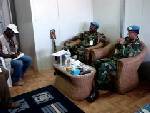
 L/R: Brooks seen interviewing the Bangladeshi Commander and UNMIL Force Commander
The Head of the Global News Network and Publishers of the GNN News Online, Mr. J. Cholo Brooks has been nominated among 15 selected journalists coming from the five continents of the world to participate in the 2006 Lorenzo Natali Prize Award for working journalists.
According to a communication from the 15th Lorenzo Natali Prize of the European Commission-DG Development addressed to the GNN boss, and signed by Zuzanna Podosek-Perrin, said, “You wrote an article entitled “Rural Liberia Gets Face-Lift from UNMIL Bangladesh Engineer Contingent which appeared on Friday, June 29, 2006 which appeared in the Liberian Times. That article of quality drew our attention and asked that you to compete the Lorenzo Natali Prize 2006 of European Commission.”
The communication further said, “The European Commission has committed itself to support and congratulate the written press journalists who will have shown remarkable judgement in their articles on Human Rights and Democracy issues in the development world,” the European Commission-DG Development communication said.
“A donation of 50,000.00 EUROS are envisaged for 2006 in order to reward the 15 selected journalists who are written and online press and working for local media in the following five world regions: Europe (Member States and Central, Eastern and Mediterranean Europe) Africa, Arab World, Iran and Israel, Asia and the Pacific, Latin America and the Caribbean,” the communication further stressed.
The communication also disclosed that the winners of the award are expected to be invited for the handing-over of the prizes which will “proceed in Brussels in May 2007.”
Mr. Brooks a former Correspondent of the BBC African Service prior to setting up the GNN worked for several news online including the http://www.africanevents/, http://www.trouwnewspaper.com/ of the Netherlands, http://www.limany.org/ and http://www.theliberiantimes.com/. His institution the GNN also publishes two weeklies, The Star and The Weekend Newspapers.
Mr. Brooks’ fearless coverage of events especially during the early days of the Liberian Civil War 1990-1996) made him to win the Press Union of Liberia (PUL) 1994 “Foreign Correspondent of the Year Award”.
According to a communication from the 15th Lorenzo Natali Prize of the European Commission-DG Development addressed to the GNN boss, and signed by Zuzanna Podosek-Perrin, said, “You wrote an article entitled “Rural Liberia Gets Face-Lift from UNMIL Bangladesh Engineer Contingent which appeared on Friday, June 29, 2006 which appeared in the Liberian Times. That article of quality drew our attention and asked that you to compete the Lorenzo Natali Prize 2006 of European Commission.”
The communication further said, “The European Commission has committed itself to support and congratulate the written press journalists who will have shown remarkable judgement in their articles on Human Rights and Democracy issues in the development world,” the European Commission-DG Development communication said.
“A donation of 50,000.00 EUROS are envisaged for 2006 in order to reward the 15 selected journalists who are written and online press and working for local media in the following five world regions: Europe (Member States and Central, Eastern and Mediterranean Europe) Africa, Arab World, Iran and Israel, Asia and the Pacific, Latin America and the Caribbean,” the communication further stressed.
The communication also disclosed that the winners of the award are expected to be invited for the handing-over of the prizes which will “proceed in Brussels in May 2007.”
Mr. Brooks a former Correspondent of the BBC African Service prior to setting up the GNN worked for several news online including the http://www.africanevents/, http://www.trouwnewspaper.com/ of the Netherlands, http://www.limany.org/ and http://www.theliberiantimes.com/. His institution the GNN also publishes two weeklies, The Star and The Weekend Newspapers.
Mr. Brooks’ fearless coverage of events especially during the early days of the Liberian Civil War 1990-1996) made him to win the Press Union of Liberia (PUL) 1994 “Foreign Correspondent of the Year Award”.
Sunday, March 4, 2007
Liberians Want former Transitional Chairman Prosecuted for corruption as "deterrent", but others disagreed

As the legal battle to prosecute former National Transitional Government of Liberia (NTGL), Chairman, Businessman Charles Gyude Bryant heats up, several Liberians in Monrovia and its environ are calling on the Liberian government to speedily bring to justice their former leader who has been charged for corruption. During an in interview with cross section of Liberians over the weekend, a team of GNN reporters gathered that most of those interviewed called for the prosecution of former Chairman Bryant and six former officials who have been charged of stealing millions of United States Dollars from government coffers.
“Former Chairman Bryant must face justice, and if found guilty be prosecuted. This will serve as a deterrent for others who are presently serving in this government and want to do the same, by stealing the Liberian people’s money,” Junior Sumo, a taxi driver given his impression about the issue said.
“We hope what has been started by this government, the Ellen led government to prosecute former officials for corruption will continue ….it should not be limited to only former Chairman Bryant’s government alone,” a middle age petty trader, Sarah Barclay in a serious tune said.
“The culture of impunity in our society must stop. Let Bryant and his former officials be given a free and fair trail, and if found guilty be brought to justice to face the full weight of the law,” Samuel Johnson, II, a student of the AME Zion Community College in Monrovia told the GNN.
As others want Bryant and others prosecuted, some others interviewed by the GNN expressed displeasure of how former Chairman Bryant and his officials are be persecuted by the Liberian people, “this is like a biblical story; those without sin must be the first to throw stone. Many of those who are calling on the prosecution of Bryant and others must be careful; if you’re in glass house don’t throw stone. This is what I can say,” Elizabeth Collins a businesswoman said.
Last week former Chairman Bryant was finally indicted and charged by a Grand Jury for “theft of property” for allegedly diverting over one-million United States Dollars during his tenure as chairman of the former NTGL. According to reports, the former chairman refused to justify to the investigators on how he utilized the US$1,397,255.00 in question.
According to legal practitioners here the former chairman’s act is in violation of Chapter 15, Section 15.51 (a,b & c) of the new penal law of Liberia which states that a person is guilty of Theft if he knowingly takes, misappropriates, converts or exercises unauthorized control over, or makes an unauthorized transfer of an interest in the property of another with the purpose of depriving the owner thereof.
For his part, former chairman Bryant challenged those who accused him of stealing money from the nation’s coffers, “"If you can prove that I committed crime when I was in office, go to the court. My lawyers will vigorously defend me. We have laws in our country. The constitution is clear,” the former Liberian leader boastfully told reporters in Monrovia.
“Former Chairman Bryant must face justice, and if found guilty be prosecuted. This will serve as a deterrent for others who are presently serving in this government and want to do the same, by stealing the Liberian people’s money,” Junior Sumo, a taxi driver given his impression about the issue said.
“We hope what has been started by this government, the Ellen led government to prosecute former officials for corruption will continue ….it should not be limited to only former Chairman Bryant’s government alone,” a middle age petty trader, Sarah Barclay in a serious tune said.
“The culture of impunity in our society must stop. Let Bryant and his former officials be given a free and fair trail, and if found guilty be brought to justice to face the full weight of the law,” Samuel Johnson, II, a student of the AME Zion Community College in Monrovia told the GNN.
As others want Bryant and others prosecuted, some others interviewed by the GNN expressed displeasure of how former Chairman Bryant and his officials are be persecuted by the Liberian people, “this is like a biblical story; those without sin must be the first to throw stone. Many of those who are calling on the prosecution of Bryant and others must be careful; if you’re in glass house don’t throw stone. This is what I can say,” Elizabeth Collins a businesswoman said.
Last week former Chairman Bryant was finally indicted and charged by a Grand Jury for “theft of property” for allegedly diverting over one-million United States Dollars during his tenure as chairman of the former NTGL. According to reports, the former chairman refused to justify to the investigators on how he utilized the US$1,397,255.00 in question.
According to legal practitioners here the former chairman’s act is in violation of Chapter 15, Section 15.51 (a,b & c) of the new penal law of Liberia which states that a person is guilty of Theft if he knowingly takes, misappropriates, converts or exercises unauthorized control over, or makes an unauthorized transfer of an interest in the property of another with the purpose of depriving the owner thereof.
For his part, former chairman Bryant challenged those who accused him of stealing money from the nation’s coffers, “"If you can prove that I committed crime when I was in office, go to the court. My lawyers will vigorously defend me. We have laws in our country. The constitution is clear,” the former Liberian leader boastfully told reporters in Monrovia.
As Sirleaf Launches Nation-wide Cabinet Meetings, Marylanders in high Gear for the arrival

Thousands Marylanders Await President Sirleaf Arrival, as she Launches Nationwide Cabinet Meeting
Preparation is said to be in progress in Harper, the administrative capital of Maryland County – home of Liberia’s 18th President, the late President William V.S. Tubman for the arrival of President Ellen Johnson Sirleaf in that part of the country at the end of this month.
Already a high power delegation of technical staff from the General Services Agency (GSA) is currently in Harper to conduct an assessment in order to prepare damaged public buildings for the arrival of the President in the county, according to the GSA Director General, Mr. Willard Russell.
The GSA Director General said after the assessment an estimate would be submitted to the Central Government at which time the funds will be provided for what he called, “quick action would be put in place for all the renovation of these damaged facilitates, including the Presidential Guesthouse, the City Hall and the Administrative Building,
Speaking to the GNN via mobile phone, an Executive of the Maryland Union, John Willie said preparations are been made for the arrival of the president, adding, “we are making necessary preparations to give the city a face-lift for the arrival of our mother,” Mr. Willie in a jolly mood said.
Observers believed the move by the president to take members of her cabinet to the people worth commendable, “this exercise been undertaken by her would afford those individuals in her government who over the years refused to visit their counties to do so by force,” Mr. Willie further told the GNN.
According to the Liberian Chief Executive the holding of her cabinet would be done throughout the country on a rotational basis, the first county to witness the arrival of these cabinet members and Chief Executive will be Maryland County.
Preparation is said to be in progress in Harper, the administrative capital of Maryland County – home of Liberia’s 18th President, the late President William V.S. Tubman for the arrival of President Ellen Johnson Sirleaf in that part of the country at the end of this month.
Already a high power delegation of technical staff from the General Services Agency (GSA) is currently in Harper to conduct an assessment in order to prepare damaged public buildings for the arrival of the President in the county, according to the GSA Director General, Mr. Willard Russell.
The GSA Director General said after the assessment an estimate would be submitted to the Central Government at which time the funds will be provided for what he called, “quick action would be put in place for all the renovation of these damaged facilitates, including the Presidential Guesthouse, the City Hall and the Administrative Building,
Speaking to the GNN via mobile phone, an Executive of the Maryland Union, John Willie said preparations are been made for the arrival of the president, adding, “we are making necessary preparations to give the city a face-lift for the arrival of our mother,” Mr. Willie in a jolly mood said.
Observers believed the move by the president to take members of her cabinet to the people worth commendable, “this exercise been undertaken by her would afford those individuals in her government who over the years refused to visit their counties to do so by force,” Mr. Willie further told the GNN.
According to the Liberian Chief Executive the holding of her cabinet would be done throughout the country on a rotational basis, the first county to witness the arrival of these cabinet members and Chief Executive will be Maryland County.
Subscribe to:
Posts (Atom)