Thursday, January 18, 2007

LIBERIANS DIED IN THE U.S., SPECIAL ANNOUNCEMENT

Wade Alema Dennis


November 13,1979 - January 13, 2007 "If friends were flowers I'd pick you"
It is with deepest sorrow that we announce the death of Wade Alema Dennis, daughter of Wade Thompson-Merchant and Cyrus S. Dennis Sr. on Saturday evening, January 13, 2007
Antoinette Browne
Sunrise March 12, 1922 - Sunset January 7, 2007
The Browne family of America and Liberia regret to announce the homegoing of their mother, aunt, sister, and grandmother, Mrs. Antoinette Browne, AKA “Ma Nettie, Nettie, Mamie, and Ma.” This sad event took place on January 7, 2007 at the residence of her daughter Roxanne in Queens , New York .
Mrs. Browne worked at the Ministry of Public Works for over 18yrs as Administrative Assistant serving several Administrations. She survive by her children, grandchildren, nieces, nephews, and a host of relatives and friends
Hamilton G. Russ
The Russ Family announces with deep regrets the death of their son, brother, father, uncle and cousin - Mr. Hamilton G. Russ. This sad event occurred on Friday, January 5, 2007 at approximately 4:00 a.m. at the Kolibu Hospital in Accra , Ghana .Hamilton leaves to mourn his loss the following:
His mother in the United States - Mrs. Margaree Clarke Russ
His companion in the United States - Joyce Green (Helen)
His special friend in Ghana - Sally Frank
His Children - Hamilton Russ Jr.(Soyee), Trokon Russ, Adrian Russ, and William Russ (Raham)
His siblings - Lenda Russ, Sam Russ Jr, Christian Russ, Oral Russ, Augusta Duncan, Esther Baker, James Russ, Menyon Russ,
Wayme Russ, Myrtle Russ, Gbenel Russ, and a host of other relatives and friends in the United States , Liberia and Ghana .

Mr. Thomas Robertson Reeves
This is to announce the home going of Mr. Thomas Robertson Reeves of Lawrenceville, Georgia.
Mr. Reeves passed away at the Our Lady of Perpetual Help Hospice in Atlanta , Georgia on Sunday January 7, 2007.
Mr. Reeves was born on January 3, 1954 in Walkers Town , St John River City , Grand Bassa County . Before his home going, he served as a Supervisor with Georgia Institute of Technology Plant and Facilities dept for more than 10 years.
T. Robertson Reeves leaves to mourn his loss his wife Gertrude, his son Maxwell Reeves of Monrovia, Liberia, his sister Charlesetta Reeves of Grand Bassa County, Liberia and a host of relatives both in the US, and Monrovia, Liberia and Grand Bassa County, Liberia.

Robert Teddie Urey
The Urey and Avorkliya Families announce with profound regrets the death of their brother, husband, father and uncle, Robert Teddie Urey. This sad event occurred on January 10, 2007 at the Wesley Long Hospital in Greensboro , N.C. He leaves to mourn his passing his wife, Hawah Avorkliya-Urey, his children; Lydia Urey Kpana, Teddie Robert Urey and Tikita Koanna Burdie Urey, his siblings, Kate White-Dennis, Earlie Urey-Fletcher* , Burdie Urey-Weeks, Esther Urey-Andrews, Emma Urey-Cassell, Roosevelt D. Urey, Benjamin K. Urey*, William E. Urey*, Anna (Muttie) Urey-Phillips, Wynston A. Urey, Genevieve A. Urey and Marie Urey-Coleman, a host of nieces, nephews, cousins, and other relatives and friends in the United States and Liberia. *(Deceased)

UNMIL's Jamaican Police Receive Peacekeeping Medals

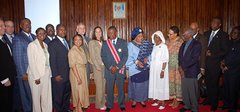
Mr. Ryan awarding medals to the Jamaican police officers

Mr. Ryan awarding medals to the Jamaican police officers
Photo: UNMIL


Monrovia, Liberia – The Officer-in Charge of UNMIL, Jordan Ryan, yesterday awarded United Nations peacekeeping medals to eight Jamaican police officers for their contributions to the peace process in Liberia.

Expressing his appreciation to the Jamaican officers for their commitment and dedication, Mr. Jordan Ryan said: “The training and mentoring you provide to the Liberia National Police officers will go a long way in building their capacity so that they can effectively and efficiently carry out their responsibilities.”

Mr. Ryan stressed the importance of continuing UNMIL’s support to the Liberian government: “Your work is contributing towards ending the culture of impunity in Liberia and re-establishing the Rule of Law in a country devastated by long years of conflict. Each and every one of you is playing an important role in achieving UNMIL’s principal objective of maintaining law and order and public safety.” The UNMIL Officer-in-Charge also urged the Jamaican officers to strictly abide by the Secretary-General’s policy of zero tolerance for sexual exploitation and abuse.

The Jamaican police contingent in Liberia comprises of five women and three men who perform a range of functions in Monrovia and in Foya, Lofa County. The medal award ceremony was attended by senior UNMIL officials including the UN Police Commissioner Mohammad Alhassan.

UNMIL Public Affairs Press Release

SPEAKER SNOWE FALLS FROM GRACE TO GRASS, KITCKS OUT BY COLLEAGUES, BUT HUMAN RIGHTS LAWYER SAYS REMOVAL IS UNCONSTITUTIONAL


The Speaker of the House of Representatives, Edwin Melvin Snowe was this afternoon by a majority votes removed as Speaker of that august body.

But a local Human Rights advocate and defender, J. Melvin Page has lashed out furiously against a group of lawmakers for violating the Liberian constitution in their attempt to unseat the Speaker of the House, Mr. Edwin Snowe.

In an interview he granted a local radio reporter, Mr. Page said the constitution of Liberia requires the House to meet in session under the leadership of its speaker except otherwise provided by law.

He said the move by some lawmakers to meet outside of the legal venue of the legislature and under the leadership of someone else while the current speaker still holds the gavel, is equivalent to a crime and should be met with harsh punishment for those involved.

The Human Rights advocate said he does not oppose the remover of Snowe as speaker but wanted to see that it is done constitutionally and legally.
46 members of Liberia's House of Representatives signed a resolution to remove Edwin Snowe as Speaker of the House, citing numerous charges.
The lawmakers said "the image of the House of Representatives has been severely damaged by the notoriety of Hon. Snowe’s pariah status as manifested by the continuous UN travel ban and asset freeze placed on him…[we] do hereby affirm and reaffirm our resolve to remove [him] as Speaker, and by this Resolution he is hereby removed".
They also want the speaker removed because of "his alleged lack of leadership ability, which left the House of Representatives without published rules and orders for more than 12 months.
The Speaker's office has reportedly received the resolution and said it will entertain debate on the issue.
Members of the house however, appear to be devided over the venue of sessions that will lead to a debate of the issue. A handful of representatives opted to hold sessions outside the capital but could not successfully do so because of the lack of quorum.

Others broke away, questioning the legitimacy of sessions held outside of the Capitol Building and without Snowe residing.
It is not yet known what will happen in the next few days but there are increasing signs that Speaker Edwin Snowe could be removed from office in weeks.

Tuesday, January 16, 2007

As Snowe Impeachment Proceeding Heats Up, Liberians Urges Lawmakers to Be Decisive


As House of Representatives' Speaker Edwin M. Snowe impeachment proceeding continues, several Liberians including youths, the elderly and Government officials are calling on the Liberian lawmakers to be decisive during the proceedings against the Speaker.

Speaking to the GNN last evening, many of those said the issue presently before the parliament should not be taken for granted, "There is a need for them to be decisive in this issue", a student of the University of Liberia, Sam Daniels told reporter.

Also a market women who spoke to our reporter said the current confusion at the Capitol must be looked into, "Those people must act responsibly, especially those who called themselves Honorables", Sara Thomas, perhaps in her late 50s said.

Meanwhile, lots of people are murmuring on the issue, especially the holding of separate sessions this week during the seating of the legislators.The first branch of government, the National Legislature finally resumed its second sitting yesterday as provided for by law.

The ceremony t was characterized by deepening controversy over attempts by some lawmakers to unseat the Speaker of the House of Representatives.

The second official sitting at the National Legislature was held at two different venues with the emergence of a new presiding officer in a process described by many as legislative coup d’etat, with the chairman of the House Standing Committee on Executive, Hon. Kettehkumeh Murray, presiding over thirty nine lawmakers at the Unity Conference Center.

House Speaker Snowe presided over the rest at the Centennial Pavilion. Though the rules of the Legislature calls for the session of the House of representatives to be presided over by the Speaker, the district #3 representative and University lecturer, Hon. Murray, is said to have taken over the leadership of the Lower House with most of the lawmakers following him. On the contrary, the embattled Speaker of the Liberian parliament, Hon. Edwin Snowe together with fifteen other lawmakers at Pavilion formally opened the Legislature second sitting though in a rather strange and unusual form and manner.

The Deputy Speaker, Sergeant –At-Arms and the chief Clerk attended the opening session of the Legislature second sitting, graced by dozens of local and foreign journalists at the Pavilion. Shortly following the opening session, the Speaker of the House of Representatives, Edwin Snowe, told a news conference at which time he accused the Executive of being the pilot to unseat him. According to Speaker Snowe, a mass meeting was held at the Foreign Ministry by the President and some lawmakers to remove him, but vowed to defeat Liberia’s youthful democracy.

He distributed cassette to journalists as evidence to his claim that certain lawmakers have received US$5,000 to unseat him. The Liberian senate held its peaceful sitting while the Lower House was divided with speaker Snowe and Kettehkumeh Murray serving as head of the same house. The embattled Speaker assured that he would use his powers to ensure that there is respect for the due process of law. It’s not known what will take place today at its formal sitting.

Sunday, January 14, 2007

US$5,000.00 Ghost Hunts Liberian Lawmakers, Will Snowe Be Impeach?


The much publicized distribution of US$5,000.00 amongst some members of the Liberian Parliament to impeach the Speaker of that august body, Edwin M. Snowe, is said to be hunting many of them, as revelations on how the amount was distributed and who is behind the impeachment proceedings has turned to a "ghost story'.

Some of the lawmakers who were opportune to have received the cash are reportedly lobbying among those who have rejected, while others (some of those who were not aware) are also opting to push forward their interest.

Some of those calling for the removal of the Speaker told reporters in Monrovia, 'We're Trying to Restore Dignity to the House'; River Gee's Elijah F. Seah Denies Conspiracy With Executive Mansion We do not need any money for Edwin Snowe's removal as Speaker of the House of Representatives.

Mr. Snowe has demonstrated since his election as speaker that he is not up to his assigned tasks for which his removal has become necessary.”w opting to push forward at all cost to stop the process in the favor of the Speaker.

However, the Liberian Legislature is expected to resume session Monday in Monrovia. The opening and plenary sessions of the House of Representatives would be held at the Centennial Pavilion.

Meanwhile, members of the House of Representatives are tomorrow, Monday are expected to resume session at the the Centennial Pavilion. This session on Monday coincide with a pending resolution to impeach Speaker Snowe.

At the same time the House of Senate is expected to resume its session tomorrow at the Unity Conference Center in Virginia. The change of venue for plenary sessions of the Legislature due to ongoing renovation works at the Capitol Building. The Houses of Senate and Representatives have been on a three-month agricultural break.

UNMIL'S Bangladeshi Troops, Commander In Rural Liberia Named Peacekeepers and Commander of the Year, 2006


J. Cholo Brooks

As Liberia enjoys relatively peace including its citizens and foreign residents, through the efforts the UNMIL, several of its troops have gone beyond their peacekeeping duties.
One of these troops is the Bangladeshi contingent assigned in rural Liberia, specifically in Nimba County under the professional commend of Lt Col Md Abdul Hoque, psc of UNMIL BANBAT 10, as Cholo Brooks reports, this group has been named as Peacekeeping troop of the Year, 2006.
Some of the United Nations troops mending peace in Liberia are said to have transformed their peacekeeping method to empowering Liberians for a better future, following fifteen years of bloody civil war in that country, which led to the destruction of the country's infrastructural and the lost of over 500,000 lives.One of these troops is the South/Eastern Asian Country of Bangladesh, which formed part of the United Nations Mission in Liberia (UNMIL) to restore peace in this West African States of Liberia.

The Bangladeshi troop, known as BANBAT-10 assigned in Nimba County is said to be spear-heading a humanitarian campaign to help the people of the county, by empowering them to acquire vocational training programs in the areas of Computer literacy, Tailoring, Basic Training on Electrical Wiring and the Repairing of Generator and Carpentry.

This contingent has transformed its military techniques of peacekeeping to providing 'free services' to enable war-ravaged people of Nimba County to be self-sufficient both in securing vocational skills to making them better and trained individuals for the future, and to be able to feed themselves, in the area of food security.

During a tour in the County over the weekend by the Liberian Times Correspondent, it was observed that the BANBAT-10 Contingent under the command of Lt./Col. Md. Abdul Hoque was seen providing several skills training programs to many of the youths, ex-combatants and some senior officials of Government of the county, including both the City Mayor of Ganta, Madam Norhn Tensonon and the District Commission, madam Emma Konah were all beneficiaries of the BANBAT-10 computer literacy training program.According to Lt./Col. Hoque, the skills training programs for the people is not only focusing on Ganta alone, but rather in five other towns, including Sanniquellie, Yekepa, Saclepea, Loguatu and Biala, adding, "the objective of this skills training program is to afford all the citizens of Nimba County.
Now the war is over, what is needed now, is for them to utilize the talents God has given them for the betterment of themselves", Col. Hoque told the Liberian Times.What interest our Correspondent during his tour in Nimba County was that the Bangladeshi Contingent was not involved in vocational skills training programs, but was also interested in food security for the people of the County, a large farm in the town of Kpein was seen being cleared by the BANBAT-10 to enable the people of the area to wisely get involve in large scale rice and vegetable production.
During the first official graduation last month from some of the training courses, offered by the contingent, several government officials including the Deputy UNMIL boss Luiz Carlos Da Costa praised the high command of BANBAT-10 for its farsightedness in preparing the youths of Nimba County to acquire skills training program, and further lauded the contingent for the Kpein town farm project.

On the farm both men and women were seen joyously making use of their farming talents, like this woman, Mary Gongloe, "we are happy for the Bangladeshi troop. These guys are good; making us to get involve in the production of our own food. They have provided us with farming tools, including tractor to help us do the clearing, while at the same time encouraging us to help ourselves", another beneficiary in a jolly mood on the farm told our correspondent.

It is somehow difficult to comprehend the high level of understanding between the people of Nimba and the entire military force of BANBAT-10, due to the cordial relationship that existing, "These guys are indeed friendly and have taken us to be part of them, the only difference is they are while and we are black", another beneficiary in a happy mood told the Liberian Times.Many of those who spoke to our Correspondent, said they hope other contingents in the UNMIL service would follow the positive example of the Bangladeshi contingent in Nimba County, "the BANBAT-10 humanitarian contribution to Nimba County needs to be emulated by others peacekeepers in the UNMIL.

If most of them are doing, like the troop from Bangladesh, especially the BANBAT-10 is doing this country will be on its right-footing in both food production and vocational acquisition by war weary Liberians", the City Major of Ganta, Norhn Tensonon said. Due to the numerous humanitarian efforts of this troop, the Global News Network is pleased to give this aware to the troop as "PEACEKEEPERS OF THE YEAR".

Saturday, January 13, 2007

POVERTY AND THE LIBERIAN MEDIA - By Moses Sandy/USA

I Left Liberia and sought refuge in the United States more than six years ago. Prior to my resettlement, I worked in the Liberian media as a journalist. I started my career in 1989 as a cub reporter within the then Television Department at the Ministry of Information Culture Affairs and Tourism (MICAT). From 1989 to the year, 2000, I rose through the rank and file of the profession.

The last position I held in the press was Editor-in-Chief, News and Public Affairs Department, Liberia Broadcasting System (LBS). I love journalism, and ingrained in me, is journalism. But one thing I hated about journalism in Liberia was poverty.

The Liberian media is impoverished. Poverty, as defined by Webster's(2000), is the condition or quality of being poor. When I was in the media, that's the kind of condition that I like most Liberian journalists, had to work and live with. We were always penniless. We had tattered and antiquated print and broadcast equipment. We read newscast from manuscripts because most news rooms neither had type writers nor computers.

We ran intermittent broadcast hours because most radio stations could not keep up with the high costs of fuel. In print, the appearance of some newspapers on the news stand was infrequent because most publishers could not afford the costs of printing. The word Internet was never a part of our daily vocabularies.

Even though some of us had college education, our monthly incomes could neither sustain us nor our families because we were underpaid. The monthly salary of most journalists at the time did not exceed $50. Some made as low as $10. And salaries were rarely paid on time. In summary, our working and living conditions were horrendous. Kato/ Gratuity Most of us barely made it. We survived on handouts or gratuities simply referred to in Liberian press corps as, kato.

Our social and economic life was hinged on the generosity of public officials and newsmakers. Even though the media is universally considered, the fourth estate of society, insinuating that media practitioners should be middle-class citizens who are socially well off, in Liberia, our situation was the irony. Literally, we were beggars.

The giving and acceptance of kato was a common practice in the media. Kato despite its ethical implications was a de facto way of life for the press. It was a common language for reporters, media and business executives, politicians, and the ordinary newsmakers. In some news rooms, kato played a crucial role in decision making regarding the assigning of news beats, news contents, and editorials. To simply put, kato was a prime factor in the gathering and reporting of news stories.

Although I left Liberia and active journalism more than six years ago, poverty as a social quandary in the Liberian media, is still the same, or it has further degenerated. Poverty and kato are evil forces that the press contend with in today's Liberia. In 2006, the Analyst newspaper in an editorial noted Journalists are amongst the most impoverished citizens in Liberia. Many live on handouts, dying as paupers.

Prevalence destitution in the Liberian press is not unique to a particular media institution. It is a problem that affects nearly all media institutions. Currently, there are 38 rural and 12 urban radio stations, 41 newspapers, and approximately two television stations in Liberia. Despite the proliferation of media institutions, professional journalism in Liberia is being hindered by poverty.

For instance, in the year, 2006, as noted by the Analyst, many Liberian journalists, who had acceded to what the paper called the highest echelon of their careers, died because they could not afford quality medical attention. The average monthly salary for a reporter as claimed by the Press Union of Liberia (PUL) former Secretary General, Frank Sainworla fluctuates $15 to $20.

In 2006, Radio Veritas, one of Liberia's finest broadcast institutions reduced its broadcast hours and let some of its best broadcasters off the hook because of financial crisis. In the same year, Star Radio, another local radio station, was constrained to redundant some of its broadcasters because of dwindle in its operating budget. The station according to reports, also intends to lay off additional staff during the 2007 fiscal year because of inadequate monetary support. At the nation’s own broadcast entity, Liberia Broadcasting System (LBS), prior to the appointment of Mr. Charles Snetters in 2006 as director general, government was indebted to the employees for 17 months.
Causation
The Liberian media does not exist in utopia. Research showed that the hardship the press corps now grapples with is a by-product of the existing economic landscape in Liberia. Eighty percent of Liberia's estimated 3.2 million people live below the poverty line and unemployment is 70 percent. Liberia experienced more than 14 years civil war. The war crumbled the nation’s economies and basic social services. Because of the decline, the media was directly or indirectly affected. For example, the market for advertisement is meager.
There are very few advertisers in Liberia and the cost of advertisement is extremely low. A full page advertisement in most Liberian newspapers according to Mr. Sainworla, costs $200. And the price of newspapers is $20 (40 cents U.S.). Liberia has a literacy rate of an estimated 38%. Because of the nation’s high illiteracy rate, readership is very low. Giving the inadequacy of funds generated from sales coupled with the astronomical costs associated with print and broadcast journalism, the Liberian media finds it extremely difficult to sustain itself.
Impacts

Poverty is negatively impacting journalism in Liberia. The impacts are enormous. But for the sake of this article, I will dwell on some of the most salient implications: inefficiency, brain drain, ethical transgressions, and dependence.
Inefficiency

Even though the Liberian media has come long way in bridging the communication gap between the government and the governed, the media is yet to reach its full potential in the gathering and dissemination of public information because of poverty. At the moment, the signals of most radio and television stations can barely travel beyond the confines of Monrovia, Liberia’s capital.
And because of high transportation costs and deplorable road conditions, newspaper circulations and coverage in terms of news gathering and reporting are limited to Monrovia and bordering counties. The inability of the media to cover the entire nation, negates rural inhabitants, who account for a greater percentage of the nation's 3.2 million population the opportunity of being a part of the global village. Such condition lay the basis for hear say amongst the people.
Brain Drain

The Liberian media is greatly affected by brain drain. Although the situation can be attributed to several causes such as death and political, poverty is also a prime element. Because of poverty, most trained and experienced journalists in search of better opportunities have literally abandoned the profession. As a result of the exodus, the Liberian press corps has seen an upsurge in the recruitment of high school drop outs, and social misfits as journalists.
The President of the Press Union of Liberia (PUL), George Barpen in a recent statement regarding the egregious situation, maintained “ Some newspapers managing editors are not high school graduates, (Allafrica.Com, 2006). The recruitment of high school drop outs and social misfits, who have myopic understanding of journalistic principles, contributes significantly to the many professional lapses in the Liberian media.
Ethical Transgressions

Poverty is one of the foremost precipitating factors for the existing credibility problems in the Liberian media. Because the press is poor and literally hungry, and some of its members are always on the look for handouts, or kato, professionalism and media ethics (objectivity, honesty, accuracy, integrity, etc) are usually compromised. For instance, in 2006, Liberia's President, Johnson Sirleaf, in an out burst about how money was allegedly changing hands in the Liberian media and the consequences it had on news contents, claimed “Some media practitioners were checkbook journalists, (Frontpageafrica, 2006).
In 2006, few months following the October, 2005 general and presidential elections in Liberia, the Carter Center and the National Democratic Institute (NDI) amid reports that some presidential hopefuls allegedly paid journalists to write favorable stories about them during the election, cautioned the press to be Mindful of the way they conducted themselves so that they are not taken for granted.
The institutions in a report noted “Those who had money to spend landed on the front pages, and those who did not, had to do with limited coverage, (Frontpageafrica, 2006).
Research on media ethics showed that the giving and acceptance of gratuities such as money and costly material things create dual relationship between journalists and newsmakers, and sometimes makes the adherence to objectivity, a cardinal principle in journalism a challenge for media personnel.
It undermines the credibility of the press and creates ethical dilemma for media practitioners in the execution of their duties. According to seasoned journalist, John Pallato, Editor of the US based eWeek.com’s Enterprise Application Center, media institutions in many societies prohibit journalists in their employ from accepting gifts because even the smallest gift carries with it the assumption that “Whose bread I eat, his song I sing.

Dependence

Giving the inability of the media to sustain itself because of insolvency, it can be argued that Liberia in truest, does not have an independent press. Liberia has an ideological independent media, which survival hinges on charity. Dependence on charity makes the media vulnerable to infiltrators.
Conclusion

Admittedly, I know that the problems and professional lapses mentioned in this article are not unique to the Liberian press. These are problems that the media in most developing countries, especially in Africa grapple with. But with a concerted effort involving the Liberian government, international community, Press Union of Liberia (PUL), and owners of media institutions, these problems no matter how herculean they may seem, can be alleviated. The Liberian government through MICAT and the PUL in particular, can address the issue of poverty in the Liberian media by seeking and mobilizing resources for economic empowerment.
To do this, the PUL must transcend its current role of media advocacy to formulating strategies that would address matters relating to the salaries and welfare of journalists, merger of media institutions with common editorial goals and objectives, costs of printing materials, bridging the digital (technological) divide, among others.

Unless the Liberian media is economically empowered, no amount of seminars, workshops, trainings, etc would reduce the existing professional lapses because the trained and experienced journalists in search of better opportunities would always quit. The first law of nature is œSelf preservation.

Thursday, January 11, 2007

Musa Bility Implicated in LPRC Corruption -Says UN Panel of Experts


The UN Panel of Expert report on the operation of the Liberia Petroleum Refining Company says the Chairman of the Board of the National Port Authority, Musa Bility is hugely indebted to the LPRC.

The report said Mr. Bility is the owner of Srimex Enterprise and Gulf Trading, two Petroleum importing companies operating in the country.

The UN Panel Report said during the first nine months of 2006, Mr. Bility paid only 125-thousand dollars out of three million dollars he owes the LPRC.

This was confirmed when a local radio station contacted Mr. Bility, he said he only owes the LPRC 130-thousand United States Dollars.

He describes the 130-thousand dollars owed the LPRC as negligible. Mr. Bility also said owing a company such as the LPRC was a normal thing in the business transaction.

He told Star Radio allegation that he owns two petroleum importing companies was incorrect.

Mr. Bility said he owns and operates one company, Srimex but collaborates with the Gulf Trading.

Cote d'Ivoire: UN's Cote d'Ivoire Mission Extended With New Mandate to Cooperate Liberian Border


New York:

The Security Council today extended through June the mandate of the United Nations Operation in Côte d'Ivoire (UNOCI) and French forces supporting it while authorizing them to cooperate with blue helmets in Liberia in preventing arms from crossing the border.

By a unanimously adopted resolution, the Council adjusted the tasks carried out by the mission, which has been deployed in Côte d'Ivoire since April 2004 helping the parties to implement a peace agreement signed in January 2003 ending their north-south civil war.

The country has been divided between the rebel-held north and government-controlled south since 2002. Under today's resolution, UNOCI will coordinate closely with the UN Mission in Liberia (UNMIL) in carrying out a voluntary repatriation and resettlement programme for foreign ex-combatants.

This is part of UNOCI's efforts to bolster the Ivorian Government in its bid to disarm former fighters, which the Council said should be carried out "with special attention to the specific needs of women and children."

UNOCI will be responsible for destroying any weapons, ammunition or other military materiel surrendered by the former combatants, according to the resolution.

Implementing an arms ban including "by inspecting, as they deem it necessary and without notice, the cargo of aircraft and of any transport vehicle using the ports, airports, airfields, military bases and border crossings."
UNOCI must "carry out its mandate in close liaison with UNMIL, including especially in the prevention of movements of arms and combatants across shared borders and the implementation of disarmament and demobilization programmes," the Council said.

In helping the relief effort for the beleaguered people of Côte d'Ivoire, UNOCI will "facilitate the free flow of people, goods and humanitarian assistance," including by helping to establish the necessary security conditions and taking into account the special needs of vulnerable groups, especially women, children and the elderly.

The mission is also tasked with supporting the organization of "open, free, fair and transparent elections, presidential and legislative, by 31 October 2007 at the latest."

The most recent report of the Secretary-General to the Council, issued last month, contained a strong call to the parties to restart their stalled peace process and resolve their disputes.

The report emphasized that the mandate of both Prime Minister Charles Konan Banny and President Laurent Gbagbo was renewed for a "final transition period not exceeding 12 months" and called on the two leaders to "eschew confrontation and maintain a constructive working relationship."

As of late last year, UNOCI had nearly 9,000 uniformed personnel supported by some 360 international civilian personnel, 500 local staff and 220 UN Volunteers.

UNMIL Jamaican Police Officers Gets "Peacekeeping Medals"


The Officer-in Charge of UNMIL, Jordan Ryan, yesterday awarded United Nations peacekeeping medals to eight Jamaican police officers for their contributions to the peace process in Liberia.


According to UNMIL Press Release quoting the UNMIL Officer-In-Charge, who expressed his appreciation to the Jamaican officers for their commitment and dedication, said, "The training and mentoring you provide to the Liberia National Police officers will go a long way in building


Mr. Ryan awarding medals to the Jamaican police officers, stressed the importance of continuing UNMIL's support to the Liberian government, asdding, "Your work is contributing towards ending the culture of impunity in Liberia and re-establishing the Rule of Law in a country devastated by long years of conflict.


Each and every one of you is playing an important role in achieving UNMIL's principal objective of maintaining law and order and public safety."


The UNMIL Officer-in-Charge also urged the Jamaican officers to strictly abide by the Secretary-General's policy of zero tolerance for sexual exploitation and abuse.
The Jamaican police contingent in Liberia comprises of five women and three men who perform a range of functions in Monrovia and in Foya, Lofa County.


The medal award ceremony was attended by senior UNMIL officials including the UN Police Commissioner Mohammad Alhassan, according to UNMIL press release.